Article
Why Technical People Struggle With People Skills (And How to Fix It)
Key takeaways
- The root cause is incentive design: technical careers reward being the smartest person in the room, which actively discourages listening, asking questions, and admitting uncertainty.
- Generic 'soft skills' training fails because it treats communication as a personality trait, not a learnable system with measurable steps.
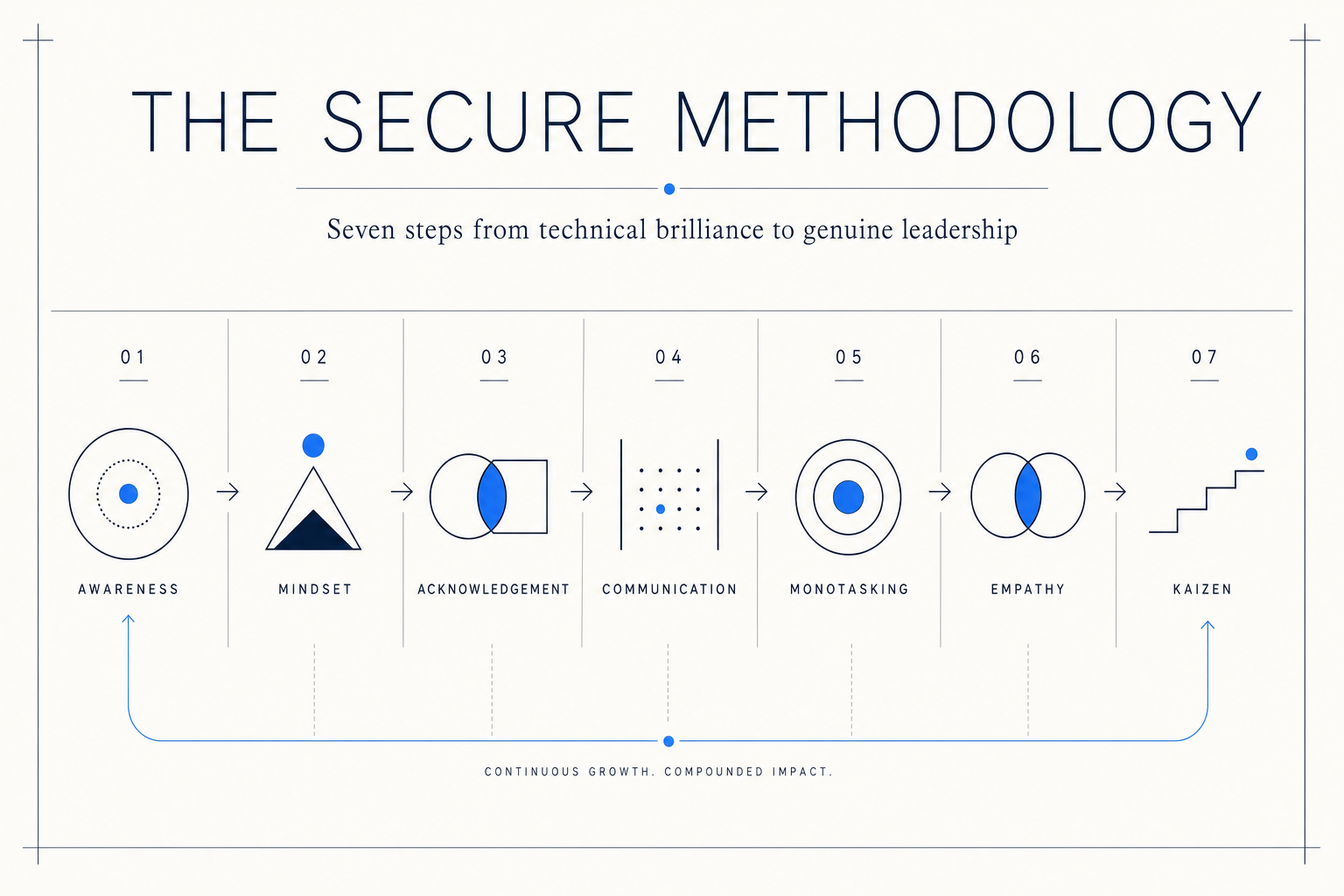
- The Secure Methodology teaches people skills in seven structured steps — awareness, mindset, acknowledgement, communication, monotasking, empathy, and kaizen — modeled on how engineers already learn complex systems.
- Companies that invest in people skills for their technical staff cut project rework, reduce turnover, and resolve security incidents faster, because most breakdowns are communication failures, not technical ones.
- Leaders must model the behavior. If the CTO interrupts in meetings and dismisses pushback, no training program will overcome that signal.
Why this matters
Every major outage, breach, and missed deadline I have investigated in 25 years of cybersecurity work has had a communication failure at its center — not a technical one. The Verizon Data Breach Investigations Report has consistently found that the majority of incidents involve human factors, and the 2024 DBIR put that figure at 68%.
When technical teams cannot translate risk to executives, cannot escalate a concern without sounding combative, or cannot admit they do not know something, the cost compounds. Projects get re-scoped late. Auditors get stonewalled. Talented engineers burn out and leave.
This is not a personality problem. It is a training gap, and it is the single highest-leverage investment a technical organization can make in 2026.
Why does technical expertise actively work against people skills?
Technical expertise rewards depth, precision, and being right — three habits that quietly sabotage every conversation outside the engineering team. The deeper someone goes into a domain, the harder it becomes to translate it for a non-expert without sounding condescending or evasive.
Three dynamics compound the problem:
- Reward for correctness. From the first algorithms class, technical people are graded on whether their answer is right. Nobody grades them on whether the person they explained it to actually understood.
- Identity tied to expertise. When your identity is 'the person who knows,' admitting 'I don't know' feels like losing status. So technical people bluff, hedge, or go silent.
- Tool bias. Engineers reach for tools first — a new framework, a new dashboard, a new policy — when the problem is almost always a conversation that never happened.
Why do generic soft-skills workshops fail technical teams?
Generic soft-skills workshops fail because they treat communication as a personality trait you either have or you don't. Technical people don't learn anything that way — they learn through systems, sequences, and repeatable practice.
A one-day 'how to give feedback' workshop with role-play and trust falls violates everything an engineer knows about how skills are built. There is no measurement, no progression, no debugging loop. Within two weeks, behavior reverts.
What works is the opposite: a methodology with named steps, clear definitions, exercises that can be practiced in real meetings, and a feedback loop. Treat people skills as an engineering discipline, and engineers will engage with it.
What does a structured methodology for technical people skills look like?
A structured methodology breaks people skills into discrete, learnable steps that build on each other — the same architecture used to teach any complex technical system.
The Secure Methodology uses seven:
- Awareness — noticing your own reactions before responding.
- Mindset — choosing curiosity over defensiveness.
- Acknowledgement — confirming you heard the other person before replying.
- Communication — adjusting language to the listener, not the speaker.
- Monotasking — full presence in conversations, not multitasking through them.
- Empathy — understanding the other person's stakes, not just their words.
- Kaizen — continuous improvement, with self-review after each meaningful interaction.
Each step has exercises, common failure modes, and a way to measure whether it is working. That structure is what makes it stick with technical people.
What does this cost a company that ignores it?
Ignoring this costs companies in three measurable ways: project delays from misaligned requirements, turnover from preventable conflict, and security incidents that escalate because nobody felt safe raising a concern early.
A SANS study on cybersecurity team performance has repeatedly shown that the highest-performing security teams are not the ones with the most certifications — they are the ones with the strongest internal communication. The skills gap most companies talk about is not really about tools or frameworks. It is about the ability to coordinate under pressure.
When a junior analyst will not push back on a senior architect's flawed design, that is not a tooling problem. That is a culture failure that costs real money.
How Christian approaches this
I teach the Secure Methodology — a seven-step framework I developed over 25 years building and leading cybersecurity teams, including as founder of Alpinist (acquired in 2021) and across consulting engagements with the Department of Defense and Fortune 500s.
My course, People Skills for Smart People, walks technical professionals and their managers through each of the seven steps with 9 hours of video, 14 exercises, and downloadable worksheets. It is built for engineers — structured, measurable, and grounded in real incidents rather than theory.
For companies, I also run team workshops that adapt the same methodology to a leadership team's specific dynamics. The goal is the same: turn communication into a discipline your technical staff can actually practice.