The Phone Call That Reset The Year
In 2022 a doctor told me I had six blood clots in my left leg. He used the words could die and could have a stroke and at any second in the same sentence. He delivered them the way doctors deliver things they've said too many times — flat, factual, no soundtrack.
For months after that appointment, I couldn't run.
I tried once, about three weeks in. I made it roughly twenty feet down a trail outside St. Louis before my left foot went numb and I had to stop and pretend I was admiring something on the ground so the guy behind me wouldn't ask if I was okay.
I missed every race I had on the calendar that year. That was a first. I'd built a lot of my identity on not missing races.
The Comeback Race
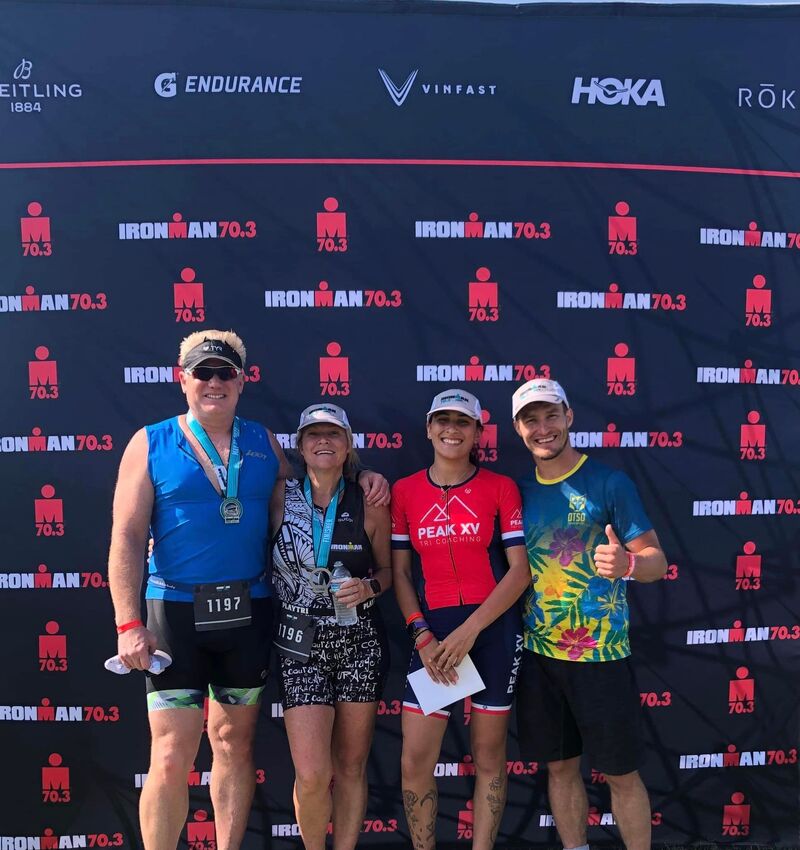
My comeback was IRONMAN 70.3 Chattanooga. A half. 1.2 mile swim, 56 mile bike, 13.1 mile run. The kind of distance that used to feel routine and now felt theoretical.
When I crossed that finish line, Don't Stop Believin' was playing over the speakers. Of course it was. Triathlons play that song the way weddings play Sweet Caroline.
I cried.
Not because of the lyrics. Not because Steve Perry hit some note that bypassed my prefrontal cortex. I cried because for the first time in over a year, I had finished something I started.
The woman in the photo with me is Melissa Espinosa. We were dating then. She's my wife now. She drove the support van, fed me, and at one point told me — kindly, but in the tone she uses when she's done negotiating — that I was going to finish whether I liked it or not. That part isn't in the photo. It should be.
What Nobody Tells You About The Comeback
Here is the part the inspirational version of this story leaves out.
The comeback isn't dramatic. It's slow. It's quiet. It's mostly boring, and a lot of it is embarrassing.
It's twenty feet on a numb foot.
It's a 30-minute pool swim that used to take you 18 and now takes you 32 because you stopped twice at the wall to catch a breath you didn't used to need to catch.
It's people passing you in the water who would have been a mile behind you a year before. People you don't know. People who don't know you used to be faster. People for whom you are, in that moment, just a slower swimmer in lane four.
It's standing at a start line you used to dominate and being grateful you're standing.
It's deciding, over and over, every single day, that you are not the diagnosis.
You're Not The Diagnosis
A diagnosis is a single sentence. You have six clots. Your scan came back abnormal. We need to talk about your numbers. Single sentences are powerful, but they are not identities.
The trap I almost fell into in 2022 was letting one sentence from one doctor become the whole story of who I was now. Clot guy. Cardiac risk. Should-be-careful guy. That language is sticky. It will reorganize your calendar and your friendships and your goals if you let it.
The work of the comeback — and this is true for the cardiac patient, the founder coming back from a public failure, the leader who got fired in a way that made the local news — is refusing to let one sentence become your whole sentence.
You are not the diagnosis. You are the person who has to walk out of the room with it.
Why This Matters For The Day Job
I run a medical device cybersecurity firm now. The work I do every day is for people in the middle of their own comeback. The patient with the pacemaker. The kid with the insulin pump. The mom whose chemotherapy pump has to work tonight, not in the morning, not after a patch window — tonight.
Those devices run on software. That software has to be secure. Not in a theoretical way. In a way that matters at 2 a.m. on a Tuesday in a hospital room you'll never visit.
That's the whole job.
I think I'm better at it now than I was before 2022. Not because of the clots. Because of the twenty feet on the numb foot. Because of the 30-minute swim. Because of the finish line in Chattanooga where I learned, in a way you can't learn from a book, what it costs a person to keep moving when nothing about the moving feels heroic.
Don't stop believing.
I mean it now.